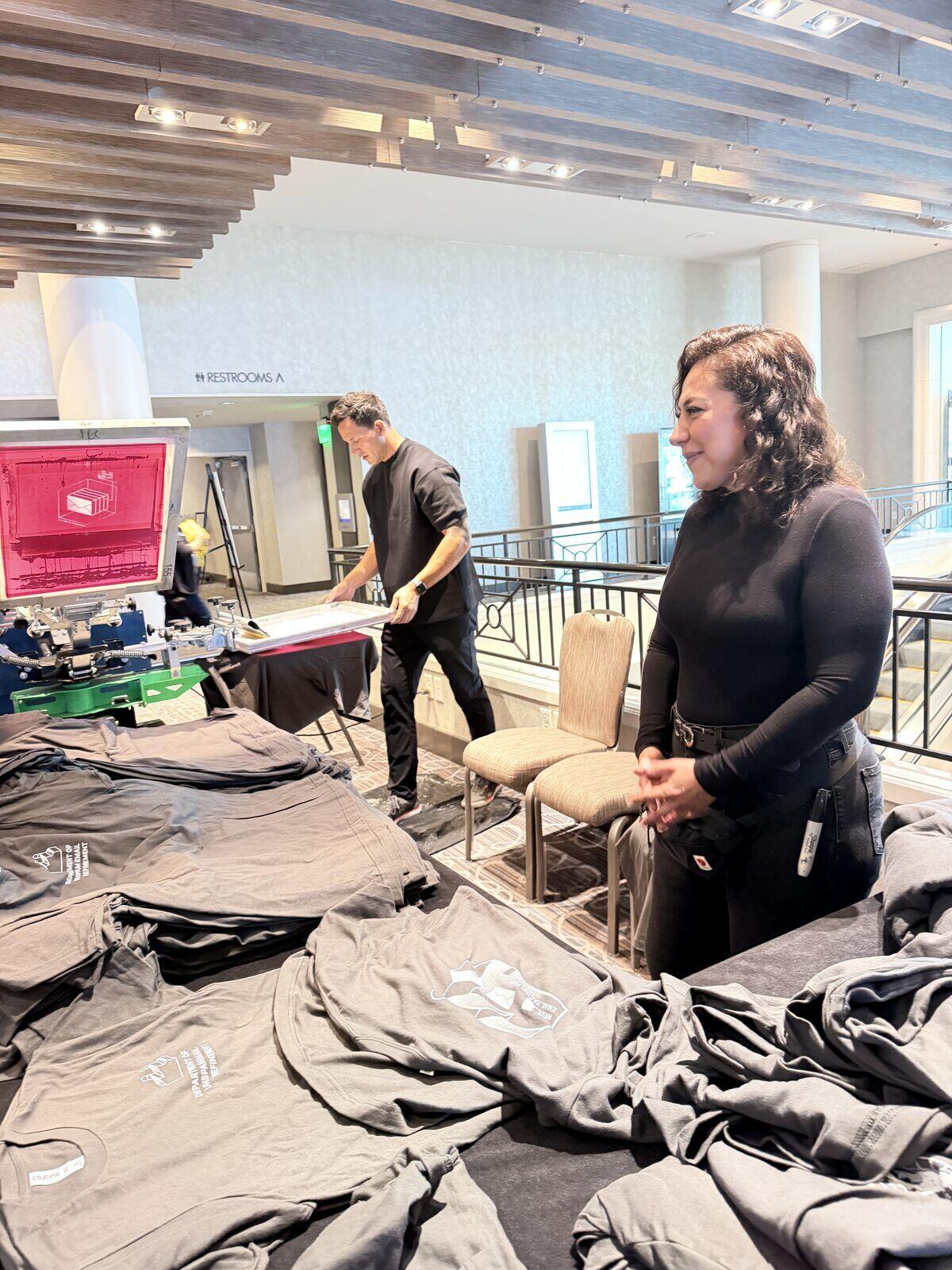
An Embroidery Bar Built Into Employee Onboarding
Most companies hand a new hire a laptop, a badge and a shirt in a poly bag. The shirt goes in a drawer. An onsite embroidery bar for employee onboarding programs changes what that moment is: the new hire picks the item, watches their own name stitched onto it, and leaves wearing something that exists in a quantity of one.
Whether it works has almost nothing to do with the machines and everything to do with whether the cadence matches your hiring volume. Here is how to fit it to an operations calendar.
Where it goes in the day
Not first thing. New hires arrive nervous and a personalization station in the first hour lands on people who have not loosened up yet. The bar works best as a break in a day of forms — after the IT and benefits block, before lunch, or as the closing beat of day one.
It is also, reliably, the easiest photo of the entire onboarding day. Internal comms will use those images for a year, which is worth mentioning when you are asking for budget.
Physically it needs very little: a table, room for a queue that will not block a corridor, and power. A lobby corner, a cafe overflow area or an open collaboration zone all work. One thing to avoid — a machine head is quieter than a heat press but it is not silent, so do not park it against the glass wall of a meeting room that hosts interviews.
Match the visits to the hiring rate
Three models cover almost everyone.
- Monthly cohort day. The best fit at roughly 15 to 40 hires a month. One half-day visit aligned to your standing start-date Monday.
- Quarterly batch. Works at 10 to 30 hires a quarter. The trade-off is real: someone who started in week two waits ten weeks, and the moment stops feeling like it belongs to them.
- Standing residency. For high-volume orgs or campuses where the bar also serves existing staff, visiting customers and a company store. The mechanics overlap heavily with our residency playbook.
And the honest version: below about ten hires a month, this is the wrong tool. A staffed local package starts around $5,000, with a flat travel fee outside Orange County, LA, San Diego and Las Vegas, and that math does not work against six new people. Run preorders and a mailed kit instead — we have laid out that comparison in onsite versus preorders. A good middle path for mid-size companies is a quarterly onsite that doubles as an all-hands moment and catches the last three months of hires, with mailed kits filling the gaps.
The minutes nobody budgets
Embroidery runs six to twelve minutes per piece. A first name in a small script sits at the fast end; a logo plus a name plus a year sits at the slow end. That is five to ten finished pieces per hour per machine head.
Run the arithmetic on a 30-person cohort and it is three to six hours on one head. No onboarding block absorbs that. Two heads gets you to a two to three hour window, and the scheduling fix matters more than the second machine: take orders at the start of the day and distribute at the end. Item, size, name, thread color, collected in ninety seconds during the morning welcome. The machines then run straight through while people are in sessions, and the handout at four o’clock becomes an event rather than a queue.
Programs that get this wrong almost always assumed embroidery moves like a heat press. It does not, and it is not supposed to — the slowness is the premium.
Pick one hero, not a menu
A single well-chosen item beats five mediocre ones, and it simplifies every downstream decision about stock and sizing.
What works: a quarter-zip or fleece, which carries a high perceived value and gets worn constantly in over-air-conditioned offices; a structured cap; a heavy canvas tote; a knit beanie for cold-climate offices; a laptop sleeve for a smaller budget. What to skip: slick performance polos, which pucker without the right stabilizer; anything with a busy printed pattern competing with the mark; and lightweight tees, where embroidery needs a cut-away backing and still reads heavy against thin jersey.
For the personalization layer, first name is the strongest single choice. Start year is a close second, and it compounds — two years in, a 2026 on someone’s sleeve becomes a quiet tenure marker that costs nothing to produce. Team or office name works in large orgs. Avoid job titles. People change roles and the garment does not.
Stock, sizes and the people who are not in the room
Hold stock between visits rather than storing boxes in a supply closet, which is where size runs go to be lost. Client-owned inventory warehoused between visits is a normal arrangement and it is what keeps a recurring program from turning into a monthly reorder scramble; the cost side of that sits in our program budget breakdown.
Carry XS through 3XL weighted toward M, L and XL — and collect size at offer acceptance, not on day one. That single process change removes the most common failure mode, which is a new hire standing at the bar while nothing on the rack fits them.
Then handle the remote hires deliberately. Either embroider their pieces during the same visit and ship them out that week, or accept that the onsite is for the in-office cohort and make the shipped kit slightly nicer to compensate. Do not pretend the two experiences are equivalent. If patches are part of the program, note that custom patches run about three weeks of lead time, so those decisions belong a month ahead of the visit rather than a week.
Frequently asked questions
How many new hires does it take to justify an onsite embroidery bar?
Around ten a month is the practical floor for a standing program, since a staffed local package starts near five thousand dollars. Below that, quarterly visits or preorder kits usually make more sense. Above roughly thirty a month, a monthly cohort day is easy to justify on its own.
How long does each new hire take at the bar?
Six to twelve minutes of machine time per piece depending on stitch count, so one machine head finishes five to ten pieces an hour. Take orders at the start of the onboarding day and hand out finished pieces at the end. The machines then run continuously and nobody stands in a line.
What should we embroider for new hires?
One durable hero item beats a menu of five. A quarter zip, fleece or structured cap all embroider well and get worn regularly. Add a first name and a start year rather than a job title, since roles change and a start year quietly becomes a tenure marker people enjoy.
Build it into the calendar
Send us your hiring volume and your standing start dates and we will come back with a cadence, a head count and a stock plan rather than a one-off quote. See pricing for program structures, call (562) 614-4800, or request a quote.