Onsite embroidery bar vs. pre-embroidered bulk orders.
We sell both, so this comparison has no thumb on the scale: sometimes the right answer is a box of finished garments that arrives two weeks early. Here's how to decide with a spreadsheet instead of a hunch.
Where the bulk order wins
Identical pieces, known headcount, no personalization: preorder, every time. Uniform programs, all-staff conference shirts where everyone gets the same left-chest mark, gifts that ship to remote employees — a production run beats a live station on unit cost, and there's no queue to manage. If nobody's name is going on anything, don't pay for a crew to stand there.
Where the bulk order quietly bleeds
- The size-curve gamble. Ordering blind means somebody guesses the S-through-3XL split. Guess wrong and you eat boxes of leftovers while your best people wear a tent or a sausage casing.
- The no-show tax. A 300-piece order for a 240-person turnout is sixty units of pure waste — embroidered with a date, unreturnable, destined for a closet shelf.
- Zero personalization. A logo hoodie is nice. A logo hoodie with your name stitched while you watched is the one that actually gets worn to the airport.
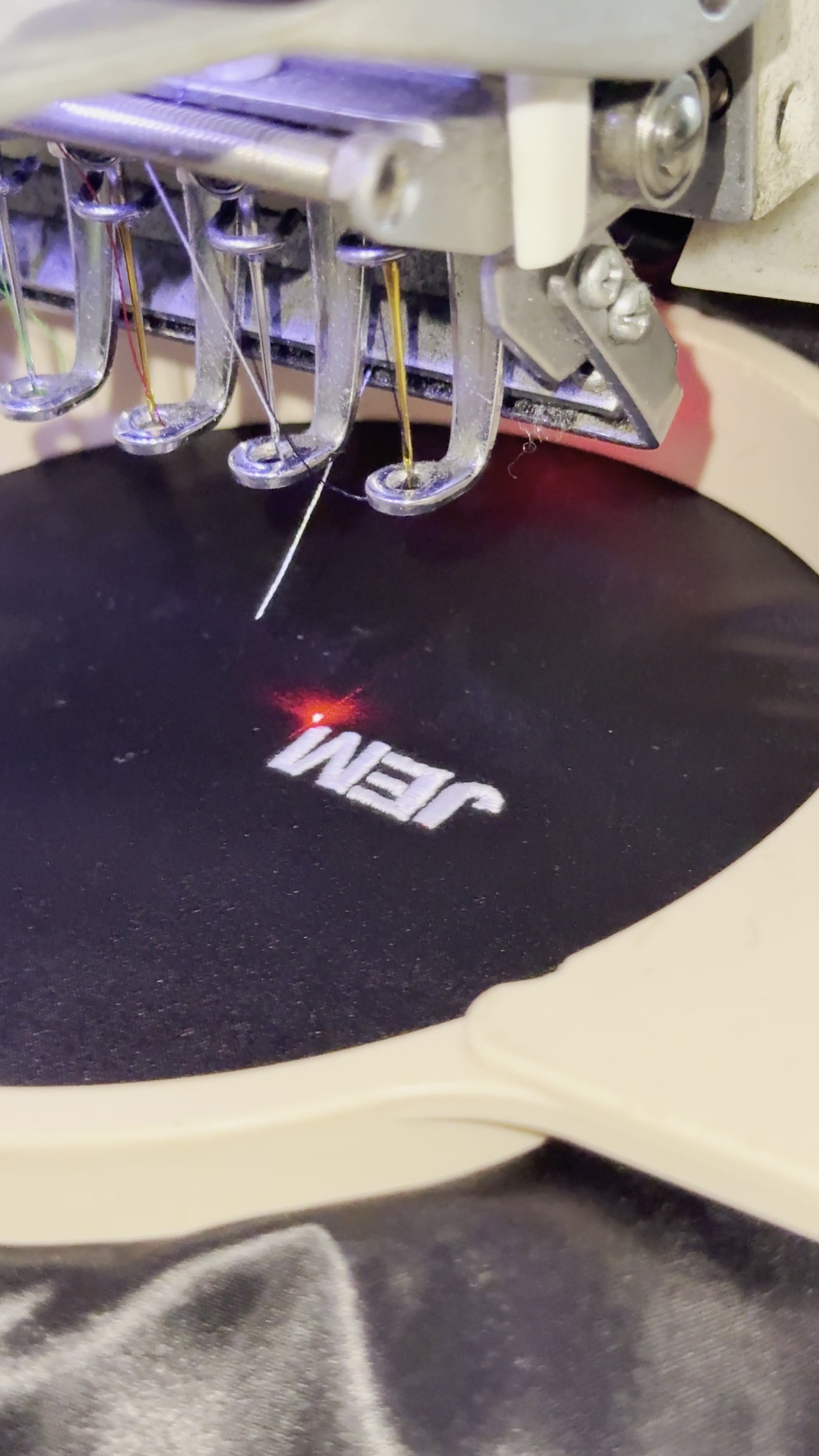
Where live onsite embroidery wins
Live stitching produces exactly what's claimed: real sizes, chosen garments, names spelled by their owners. Waste drops to the overage we plan deliberately. And the station itself is programming — a line of people watching their gear get made is an event inside your event, which no pallet of boxes has ever been.
The hybrid most ops teams land on
Pre-produce the guaranteed pieces (staff uniforms, speaker gifts) and run the bar for attendees — live personalization on caps and quarter-zips, sized on the spot, capped by the throughput math. Budget-wise it usually splits the difference; experience-wise it isn't close.
The same event, run both ways
Put the two formats against one real scenario: a 240-attendee leadership summit that historically sees about 8% no-shows on registration. The preorder path orders 300 quarter-zips to cover size uncertainty and late adds — sixty units of planned excess, purchased, embroidered, shipped, and stored before a single guest arrives. The live path stages 260 blanks across a size curve, stitches what people actually claim, and returns the unopened balance. Same summit, same garment, and the difference is not subtle: one path budgets for waste as a certainty; the other treats it as a failure mode to engineer out. When the garment is a premium piece, that sixty-unit delta alone can exceed the entire crew line for the day.
The overhead nobody invoices
Bulk orders carry costs that never appear on the decorator’s quote. Someone receives and stores pallets for two weeks. Someone staffs a distribution table and manages the size-exchange line that always forms by 10 am. Someone ships the leftovers back to a storeroom where they quietly expire. None of that is billed, all of it is paid — in facilities time, in event-staff hours, in closet space that ops teams guard jealously. A live station internalizes every one of those jobs into the crew rate: intake, staging, finishing, and a teardown that hands you a count instead of a pallet. When you compare quotes, compare the labor you are absorbing too.
The decision rule we give ops teams
Cut through it with two questions. Does anyone’s name go on the garment? And is your headcount confidence within ten percent? Personalization plus uncertainty says run it live; identical pieces plus a locked roster says preorder and save the crew fee. Most real calendars contain both kinds of dates, which is why the practical answer is usually a standing vendor who does both without a sales agenda — the split-the-difference hybrid above being the format we deploy most. The cost page has the anchors to price either side of the rule.
Which one your procurement calendar allows
There is also a boring scheduling reality. A bulk order needs the full production pipeline — art approval, embroidery run, freight — which means the PO has to clear four to six weeks before the date, and any approval-chain stall lands directly on delivery risk. A live station books on a deposit, holds crew and machines, and takes final counts fourteen days out; the long-lead item is only the digitizing, at about ten days with vector art in hand. Ops teams staring down a compressed quarter often discover the live format is not just the better experience — it is the only one their own paperwork can still make happen.
Neither answer is permanent, either — plenty of our standing accounts preorder in Q1 and go live for the summer dates. The garment list changes; the vendor should not have to.
Bring us the headcount and garment list and we'll tell you plainly which side of the line your event falls on — the form is here, and (562) 614-4800 works too.